
Driving innovation in mental healthcare through digital solutions: Key takeaways from the BMJ Digital Health Conference
December 11, 2025Post Title
Last month, our Head of Mental Health, Aileen Jackson, attended the BMJ Digital Health and Innovation Community Conference, a gathering of leading voices shaping the future of healthcare through technology.
In this blog, Aileen reflects on the challenges and opportunities for clinicians, researchers, innovators and digital health experts as they explore how data, design and human insight can transform the way we deliver care.
Attending the BMJ Future Health conference in November was a powerful reminder of the energy, ambition, and complexity driving digital transformation in health and care.
With many of our partners, the Health Innovation Network South London and Innovate UK were proud to join the conversation and showcase Mindset-XR innovations in mental health.
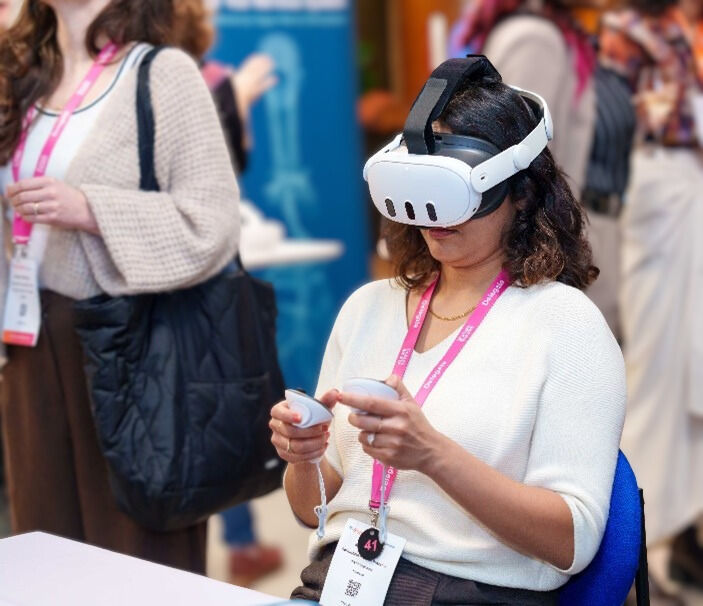
The day was rich with ideas, challenges, and opportunities, and the excitement around XR solutions was clear, with delegates queuing to experience them firsthand.
Here are the key themes I took away, along with insights from our Mindset innovators after sharing their solutions.
Short and Sweet Headlines are Best!
Short and Sweet Headlines are Best!
The urgency to innovate - but at what cost?
At the event, one thing was clear: there’s a real impatience to bring about change. The energy in the room was palpable — an eagerness to move quickly, implement digital solutions, and transform services.
That momentum is exciting, but it can also be a double-edged sword.
When we rush, we risk introducing technology that doesn’t work as intended, doesn’t scale, or fails to integrate with existing systems. Innovation is essential, but it needs to be paired with a commitment to doing it thoughtfully and well.
Moving fast is good — but moving wisely is better.
Empowering the workforce - not just digitising it
Another strong theme was empowerment. And it wasn’t just about giving people tools — it was about involving them in creating those tools.
Co-designing with clinicians and people with lived experience, building digital confidence, and ensuring technology is evidence-based are the foundations of meaningful transformation. Digital change isn’t something that can be imposed; it has to be built collaboratively.
The conference also highlighted an important reality: healthcare isn’t solely clinical. In fact, only 52% of the NHS workforce is made up of clinicians. The rest includes professionals in management, HR, training, IT, administration, and more.
For digital interventions to succeed and remain sustainable, every one of these roles must be part of the co-design process.
There was also a clear call for Royal Colleges and training institutions to embed digital skills into medical, nursing, and allied health education. Encouragingly, younger staff — often digital natives — tend to adapt quickly to new technologies. But that doesn’t mean training can be skipped. Upskilling needs to be intentional, inclusive, and continuous.
“Attending the event — both as innovators and observers — gave us valuable insights.”Emmanuel Stiels, co-founder of Reinhart
Voice technology: Timesaving or time-shifting?
Ambient voice technology was a big talking point. It has the potential to save time — but what happens with that extra time? Should clinicians use it to see more patients, or spend more time with each one? Is the goal quantity, quality, or a balance of both?
There’s no simple answer, but it’s an important question to ask. Ultimately, technology should help enhance care, not just speed things up.
“The event gave us insights into areas of clinical need and innovation that we hadn’t fully appreciated before. It has really broadened our thinking about how Harmony can best fit into the realities of frontline healthcare, and it’s given us a great deal to reflect on as we continue developing the product.”Ria Carline, co-founder of Greener Games Ltd
Tech companies: Mission-driven, not just market-driven
One clear takeaway for tech providers: stay true to your mission. Keep your focus on solving real challenges and creating meaningful impact for both patients and healthcare professionals. And remember, sustainability matters — financially and operationally — because lasting solutions are what the industry truly needs.
It’s equally important that new technologies integrate smoothly with existing systems. Without interoperability, even the most groundbreaking innovations risk becoming isolated silos.
“The National Innovation Accelerator (NIA) is clearly the route for scale once you have proven impact in real NHS settings, but their assessment lens is firmly on health inequalities, net-zero and robust real-world data, so it pays to build those dimensions into early pilots rather than retrofitting them later.”As Dr Alex Boyd, founding Executive Director of Intercultural Roots
Risk aversion vs calculated risk
Health and care systems are naturally risk-averse — and for good reason. But if we want to innovate, we need to get better at taking calculated risks, learning from mistakes, and creating safe spaces to experiment. Innovation without risk is a contradiction.
That said, risk-taking doesn’t mean being reckless. It means being thoughtful about how we frame and implement new ideas.
“An important lesson I learned at the event was that commissioners and clinicians responded best when XR tools were framed not as ‘nice tech’ but as specific, prescribable interventions mapped across a whole care pathway (prevention, active treatment and relapse prevention), with clear system benefits alongside patient stories.”Dr Alex Boyd, founding Executive Director of Intercultural Roots
Stop waiting for permission
One of the most resonant themes? The sense that many are waiting for permission to innovate. Real change often comes from the ground up. We need to empower teams to act, not just wait. Bottom-up innovation isn’t just possible — it’s essential.
There’s a cultural shift needed here — from asking “can we?” to saying “how might we?” We need to create environments where people feel confident to try, test, and learn — even if that means getting things wrong sometimes.
“Overall, the reception was extremely valuable, providing the chance to engage in rich, informal discussions that strengthened relationships and highlighted opportunities for collaboration.”Jane Ollis, co-founder of Sona Ltd
Measuring what matters - outcomes, not just outputs
There was a strong focus on measuring the impact of digital technology — not just rolling it out. This means looking at real outcomes like better patient care, improved staff satisfaction, and greater system efficiency.
Poor implementation of technologies in the workplace is increasingly linked to staff burnout and even people leaving their jobs.
We also need to manage expectations carefully. Electronic patient records (EPRs) were introduced with the hope of reducing clinical workloads, but the results have been mixed. In some cases, the challenges they were meant to address weren’t clearly defined from the start — and today, many clinicians still feel the administrative burden is heavy.
Digital systems have advanced, however, they must go further to deliver the time efficiencies and cost savings that the health and care sector needs.
People, process, and tech - in that order
The three enablers of successful digital adoption are people, process, and technology. The emphasis must always start with people. Without understanding the human and operational context, even the most advanced tech will fall short.
Process comes next — ensuring that workflows, governance, and culture support the change.
Only then can technology truly enable transformation.
“It’s good to see that patient experience is recognised as a top priority in product design.”Nicole Elias, co-founder of Photography Based Therapeutics Ltd
Final thought
I’ve always known that digital transformation isn’t just about tech — but this event was a powerful reminder of how people, systems, and culture play a part too.
We need to move fast, yes. But we also need to move wisely.
And most importantly, we need to move together.
Mindset innovators in attendance were Cineon, Greener Games, Intercultural Roots (EcoGPX), Photography Based Therapeutics, Reinhart and Sona.


