









Since 2018, the Health Innovation Network (HIN) South London has been supportingPsychologically Informed Collaborative Conversations (PIC-C), an innovative project designed to train healthcare professionals to improve how they care for people with pain by implementing psychologically informed treatment strategies.
In this blog, project leads Clair Jacobs (Consultant Physiotherapist, Physiotherapy Clinical Lead Pain Management, Guy’s and St Thomas’ NHS Trust) and Jane Robinson (Principal Physiotherapist, Sheffield Children’s Hospital) reflect on the continued success and evolution of the programme and the latest phase of their work with the HIN – broadening the scope of the training to include specialist content focused on paediatric pain.
Persistent or chronic pain affects almost 28 million adults in the UK, with 8 million of those people experiencing pain which causes moderate or severe disabling. In addition, prevalence of chronic musculoskeletal pain in children (under 18) is 25.7% – that is 274 children in the average senior school in UK (Chambers et al. 2024).
The original intention of our PIC-C project was to design a training course which helped to improve care for the huge number of people affected by pain. Specifically, we wanted to give healthcare professionals the skills and confidence they needed to treat patients with pain in a psychologically informed way – reflecting the bi-directional relationship between physical pain and emotional distress.
The PIC-C training, developed with Professor Frank Keefe at Duke University, the Physiotherapy Pain Association, St Georges NHS Foundation Trust, Kingston Hospital NHS Foundation Trust, the Q Improvement Lab and the HIN has now been running for 7 years, supporting therapists both nationally and internationally. To date, more than 400 professionals have taken part in our unique 16-week training course, including structured education and reflective supervision with many more planned already this year. An evaluation found significant positive changes in practice and professional confidence for trainees, and a celebration event is planned for 22 May 2026.
While the programme has had great success empowering physiotherapists and other healthcare professionals to provide more holistic care for adult patients, we had recognised in recent years that it could be enhanced to fully meet the needs of those working with children experiencing persistent pain. This was backed up by participant feedback. Managing paediatric pain in a psychologically-informed way comes with unique considerations – from the role of therapists in developing therapeutic relationships with parents and caregivers as well as the young person, to the delicate balancing act between the demands of school, family, friends and hobbies required to live a happy life during childhood.
A paediatric element of the training was piloted for two cohorts between 2023-2025, during which the team identified (with participant feedback) some unique needs of young people living with long term pain and persistent physical symptoms (fatigue etc.) that could benefit from some additional targeted training resources.
To address this, we secured funding from the Chartered Society of Physiotherapy (CSP) Professional Network Fund. This continues to be a very successful and enjoyable collaboration between like-minded therapists within two physiotherapy professional networks – the Physiotherapy Pain Association (PPA) and the Association of Paediatric Chartered Physiotherapists (APCP).
It was a natural ask to approach the HIN with a follow up request to work with us to clarify the need and to develop further high-quality resources, maintaining the integrity of the original project concept work. We had funding to support three short (approximately 3-5 minute) videos, to be filmed with the project team in London at Guy’s and St Thomas’, and to update the content of the PIC-C manual. The content would be co-produced by the PIC-C project team, patient partners, Your Rheum (a group for young people with rheumatic conditions) and the HIN.
As therapists, we knew what was missing from the training based on feedback – but we were a little out of our depth when it came to designing the content to fill the gaps. We certainly had no idea how to develop scripts!
The process of co-production was catalysed by our patient partners, who bravely shared their experiences with us via Your Rheum. This gave us all opportunities to work in new ways and to learn from others about the Patient and Public Engagement (PPIE) process. With help from the HIN team, structured interviews, and discussions with young people we were able to tease out three core themes: the therapeutic relationship; the challenge of eliciting values or priorities with a young person; and managing conflicting values between a young person, their parent/carer and a therapist. All felt relevant and rather than trying to create videos to “solve” complex issues related to these themes, we wanted to use the videos to explore realistic scenarios and prompt discussions during the training.
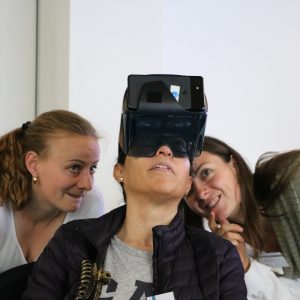
The production of the videos also included us acting, which was very daunting! However, with the professionalism of the HIN team in supporting us (alongside our patient partner Lydia Gahr and two volunteer “patients”), we produced three excellent videos. These videos have been approved by the PIC-C committee and relevant professional networks and disseminated widely to paediatric professionals at national and international conferences.
The next phase of PIC-C paediatric specific training is currently scheduled for Sept 2026, alongside further evaluation. For more information about training see Psychologically Informed Collaborative Conversations for Paediatric Physiotherapists and Psychologically Informed Collaborative Conversations (PIC-C) .
Whilst acting was excruciating for some, as a project team we learned a lot about collaboration and co-production. Lydia, our young patient partner, has a background in film production which further added to the project. We finished the co-production process confident we had created materials which sensitively and accurately conveyed the perspectives shared with us by young people throughout the work.
Thank you to the whole team – George, Natashia and Ismar from the HIN for their guidance script development, filming, post-production and content updates. Thank you also to all our patient partners credited on the videos, to Your Rheum and to the core project team and wider PIC-C team who came together to help us complete this project providing both support for therapists and improving outcomes for people living with pain and persistent symptoms.
We’ve been grateful for the opportunity to work together, and it demonstrates the value of system working when we collaborate – breaking down silos and giving everyone the chance to contribute to making the management of pain better.
HIN team
George London; Natashia Hadley; Ismar Uzeirovic.
Professional Project team
Jane Robinson, Principal Physiotherapist Sheffield Children’s Foundation Trust; Vic Harbottle, Senior Specialist Physiotherapist, Great North Children’s Hospital; Clair Jacobs, Consultant Physiotherapist, Physiotherapy Clinical Lead Pain Management, Guys and St Thomas’ NHS Foundation Trust; Elsje De Villiers, PPA treasurer and the PIC-C committee.
Patient Partners
Lydia Gahr; Project patient partners; Your Rheum volunteers.
Partner Organisations
Kingston Hospital NHS Foundation Trust; Q Improvement Lab
Find out more
To find out more about how we can help create training materials or support with multimedia content, please get in touch.
News
Latest