



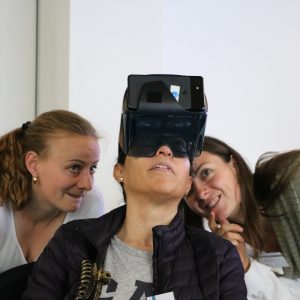







March’s Mindset-XR Innovation Support Programme spotlight shines on Neurotech – an innovative startup applying engineering and high‑tech solutions to education and medicine, creating low‑cost VR and robotics tools that improve everyday life for people who might not otherwise access them.
Their Mindset-XR product FreedomXR is a mixed‑reality digital intervention, delivered through a VR headset, designed to support adults awaiting ADHD assessment by improving executive function, enhancing focus, and reducing impulsivity. It provides an accessible, low‑cost therapeutic option that patients can begin using immediately after referral, and it can also function alongside existing ADHD treatments.
Neurotech also develops other products including Talkback VR, an immersive XR platform supporting reading engagement for neurodiverse learners, and See4Myself, a VR and mobile platform helping neurodivergent young people explore careers and future pathways.
Below, we hear from founder Dr Jonah Dearlove about Neurotech’s innovative approach to designing accessible, high‑impact digital tools for neurodivergent learners, with a focus on how their solution FreedomXR is helping shape that work.
What advice would you give budding innovators?
- Enjoy listening to your users. – they will tell you what really matters.
- Get comfortable with moving slowly. – when building trust and ensuring safety.
- Aim for simplicity. – clarity is care too!
How has feedback from patients and clinicians shaped your product?
Working with adults with ADHD drew our attention to important design blind spots. Their feedback on gamification and the level of structure required differed from our expectations and reshaped our interaction design.
Our clinical lead then helped translate those lived insights into mechanisms aligned with current neuroscience approaches to executive function.
I like that there are multiple personalisation options. It’s great that there are autism-friendly options. It makes it feel more open to someone like me.”
Participant with ADHD and autism
Why should the health and care system be excited about your innovation?
Waiting times for ADHD assessment and support remain significant, leaving many people managing cognitive overwhelm alone. FreedomXR is designed to offer structured support aimed at improving cognitive stability during these gaps.
It complements clinical care by providing earlier, scalable symptomatic support alongside existing pathways.
I have the impression that it has a lot of things that could be very helpful to me, and that there’s still so much more inside the app to explore.”
Participant with ADHD
What is the biggest challenge you have faced so far in developing your innovation?
The biggest challenge has been bringing together different ways of seeing the problem, combining neuroscience, clinical practice, lived experience and immersive design into a coherent, usable system.
Aligning those perspectives isn’t always straightforward, but it’s essential. This is how we move beyond interesting technology and towards something people can meaningfully use in their daily lives.
Overall, I’d say this is a way of achieving great things in a very fun way. It’s something I’d really like to use. I’m already anticipating it.”
Participant with ADHD
What XR success story would you like to share with us?
A key success has been translating user-centred design findings into a clinically grounded XR prototype for adults with ADHD.
Presenting this work at Leeds Digital Festival highlighted how our findings challenged aspects of conventional UX design thinking.
It demonstrated how clinical leadership, lived experience and immersive design can be developed into something practical with real-world evaluation and delivery in mind.
What type of support are you seeking most from readers to help drive your project forward?
We’re keen to collaborate with organisations, including SMEs, working on Innovate UK, SBRI, or Horizon bids that need XR expertise, embedded clinical leadership or digital therapeutic delivery experience.
We’re experienced collaborators and reliable partners and would welcome conversations with NHS teams interested in early-stage pilot work.
We’re always open to collaborative conversations and would be happy to connect. You can reach us at contact@neurotech.biz
Want to find out more about our Mindset-XR Innovation Support Programme?
Sign up to our monthly newsletter and keep up to date with all the latest news
News
Related