










Prescribe: How do I design an individualised exercise programme for pulmonary rehabilitation?
This learning resource forms part of a series: Pulmonary rehabilitation: How to prescribe individualised exercise programmes and activities.
Safety considerations
Aerobic training
Absolute contraindications (should not undertake aerobic exercise)
- Acute myocardial infarction (within 3-5 days preceding test)
- Unstable angina
- Uncontrolled arrythmias causing symptoms or haemodynamic compromise
- Syncope
- Active endocarditis
- Acute myocarditis or pericarditis
- Symptomatic severe aortic stenosis
- Uncontrolled heart failure
- Acute pulmonary embolous or pulmonary infarction
- Thrombosis of lower extremities
- Suspected dissecting aneurysm
- Uncontrolled asthma
- Pulmonary oedema
- Oxygen saturation at rest equal to or lower than 80%
- Acute respiratory failure
- Acute noncardiopulmonary disorder that may affect exercise performance or be aggravated by exercise (e.g. infection, renal failure)
Relative contraindications (senior clinician assessment required before exercise programme is agreed)
Absolute contraindications (should not undertake resistance exercise)
- Unhealed fracture
- Dislocation or unstable joint
- Situations where active range of motion or resistance work are contraindicated (e.g. post-operative protocols)
- Conditions causing significant pain during the intended exercise
- Severe inflammation
- Severe osteoporosis
- Haemophilia
- Cognitive concerns or limited mental capacity to complete the test
- Relative contraindications (senior clinician assessment required before exercise programme is prescribed. Modifications to the programme to account for comorbidities are also likely)
- Abdominal surgery or hernia
- Haematoma
- Prolonged immobilisation
- Cases where resistance training may be harmful or exacerbate the person’s condition
Resistance training
Absolute contraindications (should not undertake resistance exercise)
- Unhealed fracture
- Dislocation or unstable joint
- Situations where active range of motion or resistance work are contraindicated (e.g. post-operative protocols)
- Conditions causing significant pain during the intended exercise
- Severe inflammation
- Severe osteoporosis
- Haemophilia
- Cognitive concerns or limited mental capacity to complete the test
Relative contraindications (senior clinician assessment required before exercise programme is prescribed. Modifications to the programme to account for comorbidities are also likely)
- Abdominal surgery or hernia
- Haematoma
- Prolonged immobilisation
- Cases where resistance training may be harmful or exacerbate the person’s condition
Patients undergoing pulmonary rehabilitation are likely to have other comorbidities. Two specific comorbidities which may require adjustments to the exercise programme prescribed are:
- Balance issues. Patients with balance issues or high fall rates may benefit from additional balance exercises.
- Cardiovascular disease. Cardiovascular disease is common among pulmonary rehabilitation patients. Exercise programmes can still be a safe and effective intervention for many patients with cardiovascular disease. However, you should ensure that you have completed a risk stratification for the patient and adjusted the intensity as required before proceeding with any exercise programme. The Association of Chartered Physiotherapists in Cardiovascular Rehabilitation have produced detailed guidance on risk stratification and adjustments to exercise programmes for patients with cardiovascular disease.
Use of oxygen
If a patient has a formal oxygen prescription, they should use their normal prescribed oxygen flow rate while exercising.
Patients using oxygen should be made aware that oxygen saturations should be maintained above 80% while exercising and that if saturation drops below this level, they should stop and seek advice from a medical professional. During exercise classes, clinicians should titrate oxygen to achieve saturations above 90%.
Developing an individualised exercise programme

The FITT-VP principles
Exercise prescription can be guided by making sure you consider the FITT-VP principles – Frequency, Intensity, Time, Type, Volume and Progression. These principles can be applied to the prescription of both aerobic and resistance exercise.
- Frequency. While any exercise is better than nothing at all, your programming should try to optimise the frequency your patient trains at. Frequency should be regular enough to produce a training effect and improvement, while also allowing adequate time for recovery. The intensity of the exercise will also dictate the frequency of the exercise.
- Intensity. Intensity is a measure of the relative effort and exertion during exercise. Generally, intensity is described in terms such as light, moderate or vigorous. Intensity can be measured objectively (for example through heart rate monitoring) or subjectively (for example through Borg or RPE scales , or whether patients are able to talk during their exercise).
- Time. The length of time that someone exercises for in one session also forms an important part of your programming considerations. Exercise sessions need to be long enough to deliver a benefit, balanced against the capacity of the patient and practical considerations.
- Type. This refers to the type of exercise that a person performs, using continuous and/or interval aerobic exercises to build cardiovascular health and resistance training to build muscle strength and endurance. Your selection of exercise type will need to be tailored to the individual in terms of comorbidities (e.g. musculoskeletal impairments) and available equipment.
- Volume. Volume is the total training load of a period of time.
- Progression. In order to deliver consistent benefits, the volume, intensity and other variables must gradually increase over the course of your programme.
Alongside these FITT-VP principles, remember to consider the preferences of your patient. Prescribing exercises which the patient enjoys and feels confident performing is likely to improve their engagement with the programme.
Creating an effective exercise programme
The tables below set out guidance based on the FITT-VP principles for prescribing aerobic and resistance training, based on current clinical guidance and best practice. In conjunction with risk assessments and the preferences of the patient, these should form the basis for the exercise programme.
The programme should last at least six weeks, with a minimum of two supervised sessions each week and further sessions performed unsupervised at home.
Aerobic Exercise
Aerobic exercise programming may include continuous activity or interval training (sometimes called High Intensity Interval Training; HIIT).
Deciding on which type of aerobic exercise to programme should consider the preferences and capabilities of the patient as well as how the programme is to be delivered. Patients with severe breathlessness may find interval training more acceptable. However, interval training also tends to require closer monitoring from the practitioner.
Frequency
3 or more sessions per week.
Intensity
For strength: moderate to high intensity (e.g. For continuous exercise: moderate to high intensity (e.g. 55-90% of maximum heart rate or Borg scale 4-9; see “aerobic exercise measures of intensity” table for more details).
For interval training: high intensity (75-80% of maximum heart rate or Borg scale 7-8).
50-80% of 1 repetition maximum weight) Except for patients who are less familiar with resistance training, who should start at a moderate intensity.
For endurance: Low/light intensity (e.g. <50% of 1 repetition maximum weight).
Time
For continuous exercise: more than 30 minutes of total aerobic activity per session. Each bout of exercise should last at least 10 minutes, except for patients with very low exercise capacity.
For interval training: more than 30 minutes of activity (total including working and resting intervals). Commonly, interval training is programmed as intervals of between 30-90 seconds with a 1:1 ratio of working time to resting time.
Type
A variety of different exercise modes using large muscle groups is recommended, for example, swimming, rowing, walking, and stair climbing.
Volume
Between 150-300 minutes per week, with a minimum target of 150 minutes.
Progression
For continuous activity, start slowly and focus on increasing the time of each exercise bout initially. Work towards each session, including 30 minutes of continuous aerobic activity, before then moving on to gradually increasing intensity. A rate of progression of 5-10% every 1-2 weeks is generally well-tolerated.
For interval training: progress once Borg scores reduce to 3-4 (or below) by increasing the intensity by 10-20%.
Resistance training
Frequency
2-3 sessions per week, ideally with 48 hours between sessions to maximise recovery.
Intensity
For strength: moderate to high intensity (e.g. 50-80% of 1 repetition maximum weight) except for patients who are less familiar with resistance training, who should start at a moderate intensity.
For endurance: Low/light intensity (e.g. <50% of 1 repetition maximum weight).
Time
More than 20 minutes per session. Each repetition should take 4 seconds (1 second concentric phase, 3 seconds eccentric phase). 60 seconds rest between sessions.
Type
Your balance between strength and endurance prescription will depend on the needs of the patient.
The programme should consist of whole-body, single or multi-joint exercises, focusing on each major muscle group over the course of the week.
It is particularly important to target lower-limb strength as this is where many patients tend to have weakness. Resistance may include a variety of modalities such as free weights, body weights, resistance machines or resistance bands.
Volume
For strength: for every major muscle group exercised during a session, programme 2-4 sets of 8-12 repetitions each. The volume can be used as a tool for progression, initially starting with higher repetitions.
For endurance: for every major muscle group exercised during a session, programme 1-2 sets of 15-25 repetitions each. The volume can be used as a tool for progression, initially starting with higher repetitions.
Progression
Volume and intensity should form the initial basis for progression, starting with increasing the repetitions completed at a given intensity. Once patients are able to perform 15 repetitions (for strength) or 25 repetitions (for endurance) of a weight with ease, intensity can be increased (i.e. weight/resistance increased) and the target number of repetitions reduced to 8-10 (strength) or 15 (endurance). The process is then repeated.
The total number of sets can also be used to manipulate intensity during strength-focused training. The eventual goal should be 3 sets per major muscle group at the highest possible intensity.
Type can also be used to progress intensity, for example, moving from bodyweight to weighted exercises
Example exercise programmes
Intensity levels and helping your patient recognise the signs of over and under exertion
Before embarking on any exercise programme, it is important to discuss exercising safely with your patient. You should aim to support your patient as they develop their own ability to monitor their levels of exertion, recognising when they are under-exerting themselves (which will limit their progress) and over-exerting themselves (which increases their risk of complications). Instructions on the parameters of safe exercise should be given regularly and reinforced wherever possible (for example, included within exercise programme documents given to the patient).
As a starting point, you should help your patient understand normal physiological responses to exercise:
- Increased heart rate
- Increased breathlessness
- Increased muscle fatigue
- Increased temperature
Patients should be reassured that these responses are to be expected.
In contrast, your patient should also understand the warning signs that they should stop exercising immediately and speak to a medical professional:
- Chest pain, pressure or discomfort
- Other pain that doesn’t go away
- Extreme breathlessness (such as a feeling of gasping or choking)
- Rapid heart rate (palpitations)
Once this baseline understanding has been established, you can start to help your patient understand the different levels of intensity of exercise that may be asked of them during their rehabilitation programme.
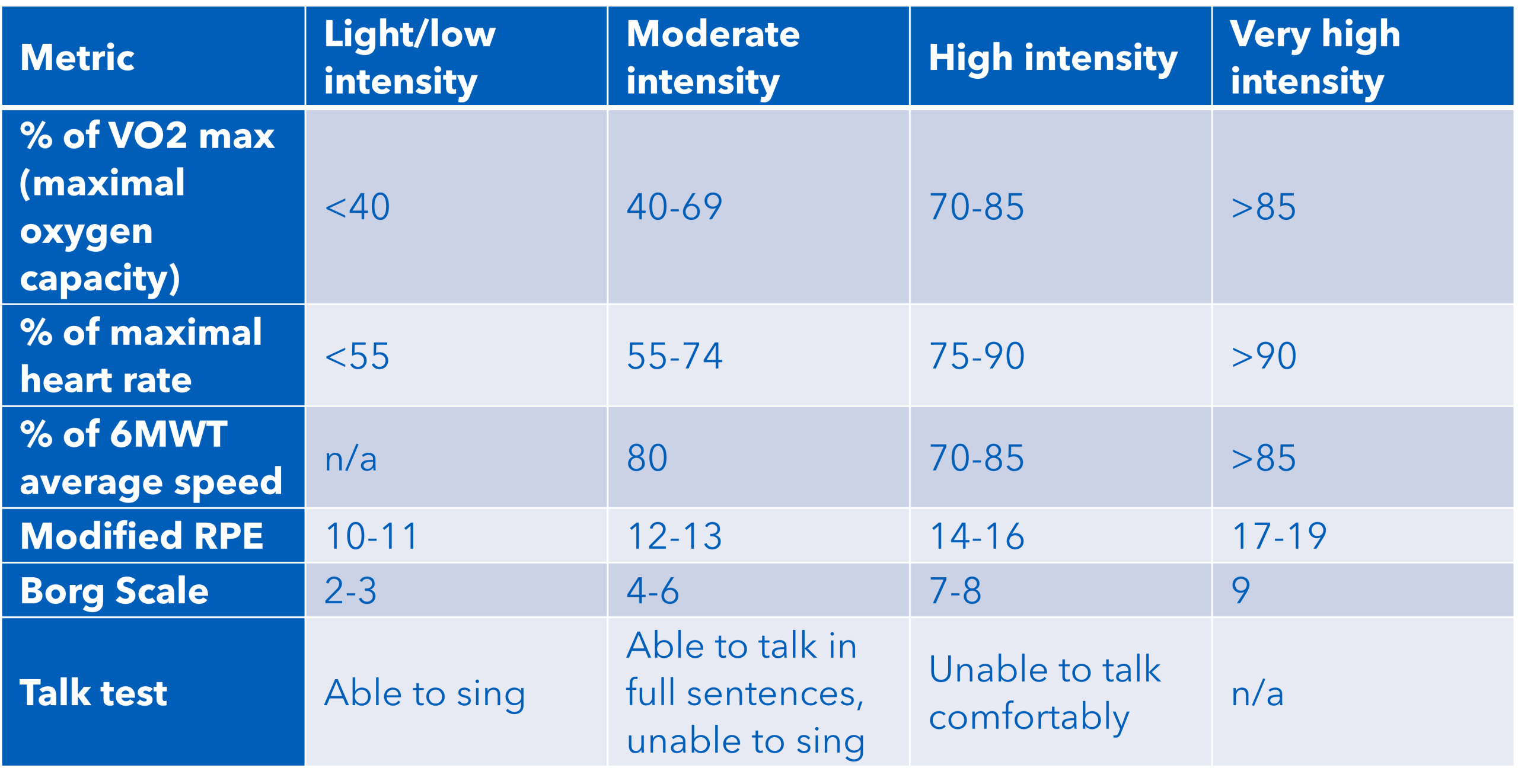
A number of objective and subjective metrics can be used to track exercise intensity depending on context and equipment available. The approximate relationship between these different measures is outlined below, adapted from the Cardiac Society of Australia and New Zealand Guidance:
Aerobic exercise measures of intensity
Resistance training measures of intensity

You should help your patient to understand Borg and Modified RPE scales so that they are able to assess whether their exercise is taking place at an appropriate intensity and make variations where appropriate (e.g. adjusting the pace of aerobic exercise).
You can also teach your patient tactics to help them manage sensations of breathlessness related to exercise:
These tactics and correct pacing will help your patient to avoid stopping during exercise as much as possible.
During supervised exercise sessions, you should monitor heart rate, oxygen saturation and perceived exertion to ensure the exercise session’s intensity remains within safe limits. In particular, any oxygen desaturation below 80% should normally entail stopping the exercise session for that individual.
It is also important to demonstrate the proper use of any weights or other equipment used during exercise sessions.
Programming warmups and cool downs
Whether supervised or completed independently, exercise sessions should always include warmup and cool down phases. Warming up and cooling are important to reduce the risk of injury or exercise-induced complications, as well as helping to optimise performance for the main conditioning phase of the session.
More detailed information about warm-ups and cool downs can be found in the Association of Chartered Physiotherapists in Cardiovascular Rehabilitation’s Standards for Physical Activity and Exercise in the Cardiovascular Population and on the Asthma and Lung UK website.
Warmups
Warmups should take about 10-15 minutes for most patients. The exception to this is patients with very low exercise capacity, who are likely to need a shorter warmup phase.
- During the warmup phase, your priorities should be:
- Mobilising all the joints and muscle groups being used during the main session through stretching.
Gradually raising the heart rate of the patient to prepare them for the cardiovascular demands of the main session. This can be achieved through increasing the intensity of exercise as the warm up progresses, with a goal of achieving a heart rate within 20 beats per minute of target heart rate, or a perceived intensity of around 11 RPE.
Good breathing control should be encouraged throughout the warmup to help with the increase in intensity.
- A typical warmup before an aerobic session in pulmonary rehabilitation could be structured as below:
- Mobility exercises (stretching)
Lower limb exercises such as marching on the spot, heel digs or side-steps for 3-5 minutes - Single upper limb movements, such as arm raises, bicep curls, lateral arm raises or forward punches (without weights) and then progressing to moving both arms together, while also moving the feet
This type of warmup would help to mobilise joints, while incrementally increasing the heart rate and preparing the body for exercise.
If using a piece of gym equipment such as a stationary bike for the main portion of the session, you could build in an incremental warmup, working at a lower intensity for a period of time before beginning the main session. As using a single piece of equipment is less likely to fully mobilise the whole body adequately, you should include mobility exercises at the start of the warmup.
If the warmup takes place seated (for example, due to cormorbidities), you should make sure that the patient moves their legs and feet as much as possible to avoid venous blood pooling.
Cool downs
Cool downs are equally important to warm-ups for reducing the risks of exercise-induced complications. The objectives for a cool down are to:
- Gradually lower the heart rate following the main portion of the session, aiming for a heart rate around the resting rate of the patient by the end of the cool down.
- Stretching to reduce soreness following the exercise.
The cool down can be structured in a similar format to a warm up but in reverse – starting with higher-intensity exercise and reducing the intensity as it progresses. Asthma + Lung UK have examples of cool down exercises on their website.
Further support to help patients achieve their exercise goals
Goal setting
Some healthcare professionals find that setting goals with patients to be a useful motivational exercise, as well as helping with exercise selection for the patient’s programme. Goals may have a beneficial effect on programme adherence if patients can see they are making progress towards or achieving their goals. Conversely, there is also the potential for goals to have a negative impact on motivation if they are not met and the patient feels they are “failing”.
If set, goals could reflect successful progress through the exercise programme (e.g. reaching particular distances for aerobic exercises or weights for resistance training). Goals could also be linked to personal or vocational activities or ambitions, such as:
- Being able to complete activities of daily living (such as walking to the shops or climbing stairs), being able to complete these tasks with fewer symptoms, or completing particular activities on a more regular basis.
- Being able to return to work.
- Taking part in sports or completing particular athletic activities (e.g. walking or running a 5k).
Goals should be agreed as “SMART” objectives (Specific, Measurable, Attainable, Relevant and Timely) and revisited as appropriate with the patient. You may wish to use motivational interviewing techniques to help frame goal setting.
Activity diaries may also be helpful for tracking both completion of prescribed exercise programmes and progress against goals set by the patient.
Apps and other digital tools
A wide range of personal digital tools, including mobile apps and wearable devices, are focused on supporting physical activity in the general population.
At present, none of these digital tools are routinely recommended for use during pulmonary rehabilitation. Some studies (example) have looked at the use of digital tools during pulmonary rehabilitation for COPD patients. The results of these studies have been inconclusive in terms of benefits and indicate that a significant proportion of pulmonary rehabilitation patients experience difficulties using digital tools.
Some more digitally confident patients may choose to use digital tools for elements of their pulmonary rehabilitation, such as app-based activity diaries or joining online exercise classes.
The pace of change in this area is rapid. For the latest developments, look for recommendations from trusted sources such as the British Thoracic Society or encourage patients to look on the NHS Get Active website.
Ready for more?
Move on to the next part in this series:
Progress: how should I adapt an exercise programme based on patient response and other factors?