


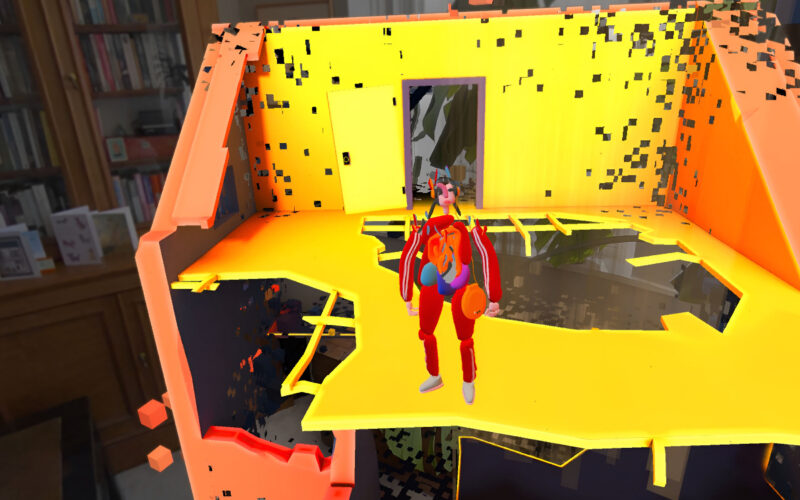
In August’s Mindset-XR blog, May Abdalla, CEO and founder of Anagram, an award-winning creative studio that develops immersive storytelling experiences using emerging technologies, and Omar Mentesh, founder and CEO of Anabranch Plus, a rehabilitation and employability organisation that supports people affected by the criminal justice system, including prisoners and prison leavers, reflect on their collaboration on Impulse: Playing With Reality.
The immersive mixed reality documentary uses the real-life stories of four people with ADHD to explore how impulsivity, attention and emotion shape the way they experience the world.
Overview
When we began developing Impulse, ADHD was becoming increasingly visible in headlines and on social media. But greater visibility did not necessarily mean greater understanding.
Behaviours associated with ADHD, such as lateness, interruption, inconsistency or impulsivity, were still often interpreted as personality flaws or moral failings. At the same time, descriptions of ADHD could prompt people without the condition to respond, rather flippantly: “I feel like that too”. It felt as if the conversation around ADHD had stopped being about how people with the condition could be supported and genuinely understood, and had become more focused on the opinions of neurotypical people.
This created an interesting challenge. How could we communicate not simply what a person with ADHD might do, but something of what their lived experience could actually feel like?
That question made immersive technology particularly interesting. Rather than asking an audience simply to listen to someone describe their experiences and interpret them through their own lenses of perspective and understanding, mixed reality gave us an opportunity to translate aspects of attention, overwhelm, boredom and impulsivity into something people could be immersed in within the space around them.
However, if an immersive experience is intended to help an audience understand someone else’s reality, the people who have lived that reality need to play a central role in shaping it.
For many of the lived experience collaborators on the project, the behaviours and thought processes the team wanted to explore were simply “normal”. Their contribution was not to provide a textbook explanation of ADHD, but to describe honestly what those experiences looked and felt like in their own lives.
Collaboration needs to start while there is still something to change
Terms like “co-design” and “co-production” are increasingly used across innovation and quality improvement in health and care. But there is a risk that trying to align collaboration to a set of understood terms or ensure the fidelity of a particular involvement process can become more important than the quality of the collaboration itself.
For Impulse, we would describe the process as sustained collaboration rather than a single methodology for meaningful involvement of people with lived experience.
The project included an expert advisory panel, more than 100 hours of interviews with people with ADHD, and repeated conversations as the story and interactive elements developed. Contributors were able to see how the work was changing and continue to challenge the team throughout the process.
Starting early was important to us; meaningful collaboration means involving people early enough that what they contribute influences the foundation of the work. If an experience has essentially been completed and people with lived experience are invited to react to it, that can still provide useful feedback – but it is not the same as creating something together.
Collaboration also means being able to disagree without disagreement becoming awkward. Lived experience contributors should be treated as people with a perspective on the whole piece of work, rather than being brought in simply to “supply the emotional bit”.
That requires creators to ask questions without assuming they know what the answers will be – and to be prepared to hear things which may make their original plans or ideas more complicated.
Letting lived experience complicate the work
One of the most important lessons from Impulse was that lived experience should not simply validate what creators already believe.
It should – it must – be allowed to complicate the work.
There is no single experience of ADHD. What helps one person may constrain another. Two people may respond completely differently to a similar situation. Social circumstances and the environment around someone can be just as consequential as a diagnosis itself.
That complexity can be uncomfortable when you are trying to create a coherent story which someone without lived experience can comprehend in a matter of hours or even minutes. There is always a temptation to find the cleanest example or the simplest narrative.
But people’s lives rarely work like that.
For us, collaboration meant resisting the urge to flatten complex experiences into neat case studies. It meant making room for contradiction and staying in relationships with contributors long enough for them to challenge the assumptions being made.
Trust is particularly important here because the most useful insights do not necessarily emerge from the first conversation.
People often begin with the “tidy version” of their story – the version they have become accustomed to telling other people. The details which can fundamentally change a piece of work may only emerge later, once someone trusts that the person listening will not judge them or shy away from the more difficult parts of their experience.
This was something we saw repeatedly during the development of Impulse. An abstract discussion about ADHD could suddenly become much more meaningful when someone described the real-world consequences of a particular behaviour – and what was happening underneath it.
It was often these ordinary, specific details that audiences subsequently connected with most strongly.
What does meaningful collaboration look like in practice?
There is no perfect formula for working with lived-experience experts, but our experience with Impulse highlighted a few principles which we think are useful for anyone developing innovations or creative projects that involve sensitive or personal experiences:
- Start early. Speak to people while fundamental parts of the work can still change, rather than waiting until there is a polished product to respond to.
- Build relationships, not just research sessions. Insight often develops over time as trust grows and conversations become more open.
- Be clear about the relationship. People should understand why you are asking for their involvement, how their contributions may be used, how much involvement they want and what will happen next.
- Create space for disagreement. The aim should not be to secure endorsement for an existing idea. Contributors need to be able to challenge assumptions and influence decisions.
- Recognise people’s contribution properly. Lived-experience involvement requires time, expertise and often significant emotional labour. Where possible, that contribution should be paid fairly.
Many of these principles overlap with the Health Innovation Network South London’s Involvement Strategy.
Perhaps most importantly, creators should distinguish between asking somebody to tell their story and genuinely allowing that story to shape what is being made.
The first is relatively easy to organise. The second requires more time, flexibility and willingness to change direction – but that is where much of the value lies.
Can an immersive experience change what people actually do?
For Impulse, an important question remained after the creative process was complete: does an experience like this create a momentary emotional response, or can it have a longer-lasting impact?
US philanthropic organisation Agog initially supported a review of research into the impact of virtual reality published since 2018. While there was considerable evidence that immersive experiences could produce immediate changes in knowledge and attitudes, there was less evidence about what happened afterwards – particularly whether these changes affected people’s behaviour.
Agog therefore commissioned a longitudinal impact study of Impulse.
The study collected data from 118 participants before and immediately after experiencing Impulse, with 106 completing a follow-up approximately one month later. The findings suggested that some of the changes associated with the experience persisted after the headset came off.
Participants showed lasting gains in their understanding of what ADHD can feel like from the inside. Ninety per cent reported increased empathy towards people with ADHD, while 80 per cent reported behaving more patiently towards people with ADHD in their lives. Participants also described changes such as adapting schedules, environments and communication styles. Among participants who suspected that they themselves had ADHD symptoms, more than half had sought support from another healthcare professional by follow-up.
The study was not designed to establish whether Impulse is more effective in mixed reality than the same stories would be as a film or written testimony, so its findings should not be interpreted as a simple demonstration that “VR reduces stigma”. Instead, they point towards something more interesting: recognition, empathy, reflection and behaviour may form part of a longer process that continues after an immersive experience has ended.
The technology is only part of the experience
For innovators working in XR, it can be easy to focus on what new technology makes possible: greater immersion, more sophisticated interactions or new ways of blending physical and virtual environments.
These possibilities are exciting. But when technology is being used to represent people’s lives – particularly experiences involving mental health, disability, trauma or stigma – technical sophistication cannot substitute for meaningful collaboration.
Lived-experience experts help creators see assumptions they may otherwise miss. They introduce contradictions that make stories more truthful. They can explain the difference between how a behaviour appears from the outside and what is actually happening underneath it.
Ultimately, those perspectives can make immersive experiences not only more authentic, but more relevant to the people they are intended to support and more powerful for the people experiencing them.
For organisations unsure where to begin, our advice is deliberately straightforward: start with one person.
Be honest about what you are asking them to contribute, what you can offer in return and what they genuinely have the opportunity to influence. Do not wait until you have a polished product, or even a fully-formed plan. And do not confuse running a focus group with building a partnership.
The objective should not simply be to demonstrate that people with lived experience were consulted. It should be to create something which could not have been made in quite the same way without them.
Find out more
Impulse: Playing With Reality is available on Meta Quest, and further information about the experience, upcoming screenings and the recently published impact study is available through Anagram and the Impulse website.
Blogs
Latest