


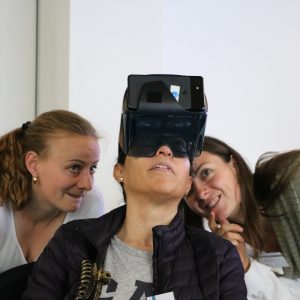








In February 2024, the Health Innovation Network (HIN) South London and UKRI announced a multi-year innovator support programme focused on immersive therapeutics for mental health. As part of this initiative, we’re supporting 50 projects that are seeking to revolutionise mental health care in the UK through immersive digital mental health therapeutic innovations.
These companies are part of the first strand of the programme. Additionally, you can learn about the companies we’re supporting in the second strand and third strand. Below you can find out more about the companies we’re supporting for this round:

The NHS loses an estimated 6 million days a year to mental health issues, costing over £118bn annually. In response, We Are Anagram Ltd., in partnership with the NHS and the University of the West of England’s School of Health & Social Wellbeing, has developed an immersive empathetic training program called Inside Mental Health.
This innovative tool is designed to improve empathy and reduce stigma for healthcare professionals working with patients experiencing mental health issues.The training involves participants watching Goliath: Playing With Reality in virtual reality while wearing heart-rate monitors. This approach helps healthcare professionals better understand their patients, themselves, and their colleagues, leading to improved patient outcomes. Additionally, this tool offers a cost-effective way to address mental health challenges within the NHS.

Millions of people in the UK are affected by mental health conditions such as bipolar disorder (BD), psychosis, depression, and anxiety disorders, which significantly impact their lives and those of their caregivers. Relapse prevention is crucial for individuals in remission, supported by interventions like “Staying Well Plans.”
StayingWell XR is a mixed reality (MR) application that empowers service users to explore and identify signs of potential relapse in conditions like BD, psychosis, or depression. A completed feasibility study has produced operational software that combines MR with a desktop interface, allowing users to select relevant symptoms and express them in the MR headset while working with their therapist to explore their “relapse signatures.”
Brainspark Games is a pioneering neuro games technology company that builds GCSE games. This tool is an AI-powered, culturally inclusive educational mobile game aligned with the UK national curriculum for 7- to 13-year-olds.

Individuals living in residential care homes often experience social isolation and have limited access to communal activities. Virtual Choirs is an XR therapeutic tool designed to enhance the mental health and well-being of people in residential care and other isolated settings. It offers an immersive, therapeutic group singing experience, placing participants at the centre of a pre-recorded choir filmed in visually stunning locations across Scotland.
It can be easily integrated into daily routines, delivering scheduled group sessions or on-demand individual sessions, providing both staff and residents with flexibility and ease of use. This project offers a unique opportunity to improve the quality of life for a large, underserved patient group, addressing the critical need for innovative mental health interventions for the ageing population.
Project: Hark, a VR-based interactive narrative game and meditation app hybrid to help manage digital addiction in young people.
Anxiety and depression affect millions globally and cost the NHS around £10 billion annually. Many game-based digital mental health initiatives (gDMHIs) integrate proven therapeutic techniques but often suffer from low user engagement.
Hark is a VR-based interactive narrative game and meditation app hybrid designed to help manage digital addiction in young people. It aims to bridge the gap between game design and medicine by creating an engaging digital entertainment experience where therapeutic modules can be seamlessly integrated.
The goal is to provide an appealing, entertaining experience that also fulfils therapeutic objectives, increasing both user engagement and effectiveness.
Project: Improving Service Access using Virtual Exposure (iSAVE)

Many patients experience anxiety around receiving medical treatments, ranging from brief worries to severe phobias. It’s estimated that 30% of all MRI patients report anxiety, and disrupted MRI appointments due to anxiety or claustrophobia cost the NHS approximately £11.2 million in 2017-2018. This avoidance of treatment or diagnostic procedures can negatively impact patients’ health. Current solutions like therapy or sedation are often expensive and time-consuming.
iSAVE is a project designed to improve service access for these patients by using virtual reality (VR) exposure therapy. The VR tool incorporates innovative eye-tracking hardware and software embedded into the headset, which monitors patients’ anxiety levels in real time. AI personalises the experience by adjusting the level of exposure based on the patient’s anxiety levels, identified through their eye movements. This personalised approach helps reduce patient anxiety and offers a cost-effective solution for the NHS, improving the overall experience and treatment outcomes for patients.
Project: Mentis, building an AR or VR digital service delivered through a smartphone that incorporates state-of-the-art cognitive-behavioural science and neuroscience.
FinIQ™ – Building Psychological Readiness for Credit through XR games

Financial education has been shown to not only relieve financial anxiety but also improve confidence in money management and enhance financial capability. However, those with low financial well-being are more likely to experience mental health issues, which can worsen their financial situation.
To address this, Good With has developed the FinIQ™ financial psycho-educational pathway, offering young adults a gamified financial education experience based on Cognitive Behavioural Therapy (CBT) principles. This approach helps reduce financial anxiety, build confidence, and improve financial capability in young adults through an engaging, game-based platform.

InsideOut offers convenient on-demand mental health tools that provide tailored content and experts. Additionally, they can offer booking appointments with experienced coaches and therapists and put a plan in place to achieve agreed milestones.

NeuroXRFitness is a groundbreaking XR technology leveraging AI for digital mental health. This AI solution incorporates both music therapy and gamification, to support individuals and revolutionise mental health care.
Project: M-Fit, improving the wellbeing and mental fitness of people and productivity of companies.
NeuHealth Ltd is a Mental Fitness startup that aims to enhance the well-being and mental fitness of individuals and improve the productivity of companies. They customise and embed proven evidence-based mental fitness interventions that produce measurable improvements in mainstream gaming and branded company training programmes.
Project: Empathy-XR, an immersive AI-based tool for mental health wellbeing.

Empathy-XR is an immersive AI-based tool that supports individuals with their mental health well-being through immersive and engaging technology.
Project: VR hypnotherapy as an early intervention for anxiety in students and young people.

Phase Space addresses the growing mental health crisis among adolescents and young adults (15 to 24 years old) by offering a VR-based early intervention that provides rapid relief from stress and anxiety in just 7 minutes.
It also helps users build long-term coping skills. Phase Space can be used as “first aid” during panic or anxiety attacks, integrated into counselling sessions, or as a short practical course in anticipation of stressful events like exams or job interviews.
The app improves the quality of care for patients, fosters lifelong mental health resilience, and reduces the need for more costly interventions.
Project: Planet WellBeing, using extended reality to improve mental health and reduce loneliness.

The Planet Wellbeing tool aims to tackle loneliness among elderly people by helping participants work together on meaningful collaborative tasks in an accessible virtual space. The product seeks to reduce loneliness and lessen the need for healthcare services, requiring less staff and being more cost-effective.
Dragons of Afterlands: Implementing an AR-social board game that improves wellbeing into education and healthcare settings
Adolescent mental health is a growing societal issue. While CAMHS traditionally supports young people with mental health challenges, increasing pressures on these services have shifted much of the responsibility to schools. With new government and Ofsted requirements, schools are now expected to demonstrate how they support the mental health and well-being of students.
In response, Play Well For Life Ltd. developed Dragons of Afterlands which builds on the success of their previous Mindset XR Strand 1 initiative. This augmented reality (AR) board game is a scientifically backed psychological intervention for adolescents, co-produced by young people, teachers, and clinical psychologists. As schools take on a more prominent role in supporting youth, Dragons of Afterlands provides an engaging, evidence-based well-being intervention, helping improve mental health in a school setting.

Elderly adults in UK residential homes often face barriers, such as physical or mental health challenges, that exacerbate feelings of isolation, loneliness, and apathy.
Recreo VR offers a virtual reality solution specifically designed for people in care, providing 360-degree experiences tailored to improve both mental and social well-being. This easy-to-use tool is already being utilised in care settings, charities and the NHS across the country.
The VR tool hopes to improve the mental well-being of patients while offering healthcare systems a reliable tool with a range of scenarios to support patients in care homes.
VR THERAPY + CLOSE LOOP VAGUS STIMULATION

DR.VR is a Class 1 medical device developed by Rescape to alleviate pain and anxiety in patients during medical procedures. The system includes a VR headset, tablet, and router, allowing clinicians to control and monitor what the patient experiences.
By immersing patients in calming virtual environments, DR.VR helps reduce the need for pain medication and general anaesthesia, shortening procedure times and lowering hospital costs. DR.VR is deployed in over 80 NHS locations and supports a holistic, biopsychosocial approach to chronic pain management.

Their games are designed to be fun and engaging, while also providing a safe and supportive environment for players to practice and improve their social skills.
With their AI-powered learning, players receive personalised feedback and guidance, making the learning experience more effective and engaging.

SyncVR Medical UK LTD (syncvr.tech) is on a mission to improve healthcare with VR/AR (XR). We are the largest XR Platform for European/UK healthcare, providing XR solutions to over 200 healthcare institutions in NL, DE, DK, SW, BE, UK and FR. Next to numerous patients and healthcare staff benefiting from applications on the SyncVR Platform, >40 third-party developing companies supply their XR healthcare app through our Platform. Before 2026, we aim to be the dominant XR Platform in the top 5 European healthcare markets.
SyncVR Medical UK Ltd is a market leader in providing extended reality (XR) solutions in healthcare, including virtual reality (VR) and augmented reality (AR).
We’ve worked in collaboration with South London and Maudsley NHS Foundation Trust on Project Auxilium to develop an application that provides DBT (dialectical behaviour therapy) for (waitlisted) young people with mental health issues. The application helps patients recognise emotions in themselves and others and learn coping skills to deal with the mentally most difficult situations in daily life.
Project: SpiritVR, a VR application to aid with mental health and wellbeing.
According to an NHS England survey in October 2023, one in five children and young people in England aged 8 to 25 had a probable mental disorder. Scenegraph Studios Ltd. has developed Spirit VR, an innovation that offers a six-part mindfulness course created with input from mindfulness practitioners and clinical professionals. Spirit VR helps users manage their mental health both within and outside the app by teaching mindfulness skills that can be applied to everyday life.

Squidsoup’s Mixed Reality technology, Submergence, explores penetrable volumes of light through hundreds of strands of individually addressable LEDs, mapping 3D virtual architectures into shared physical spaces. Developed over 10 years, Submergence has been experienced by millions worldwide, from galleries to festivals.
This immersive and abstract experience blurs the line between the real and digital, evoking personal interpretation and emotional responses. Anecdotal evidence suggests it has potential in healthcare, improving wellbeing and encouraging collaborative behaviour.

Tycho Medlink addresses cognitive impairment in individuals with neurological conditions, ageing populations, and those who have experienced brain injuries or strokes. This digital therapeutic tool, in the form of an app, helps users relearn everyday tasks and engage in high-intensity cognitive training remotely, all from the comfort of their own homes. It targets issues such as memory, attention, and problem-solving. Clinicians can track patients’ progress, ensuring individuals receive personalised, evidence-based care remotely.
Project: overcoming social anxiety through immersion in VR.

AI-powered soft skills training in virtual reality (VR), mixed reality (MR), and online, for public speaking, interviews, difficult conversations, and more.

TheraVR closed-loop technology is a wearable headset that measures blood oxygen, heart rate variability, respiration rate, and ECG in addition to high-temporal resolution EEG using embedded sensors.
New VR application to support people that self-harm
XR Therapeutics are looking to forever change the way the mental healthcare industry approaches mental health conditions. Utilising custom-built digital environments, empowering therapists to engage directly with clients within the scenarios that can impact them, fostering targeted intervention and personalised care like never before.
Our software provides a visual aid for the client when undergoing mental health treatment. It combines elements of clinically evaluated talking therapies with immersive and visual content that can be streamed on a variety of hardware solutions. It is a tool for therapists that makes their treatment more effective and efficient.
XR Therapeutics is currently working with NHS trusts to treat patients on waiting lists who may not have been successful with conventional talking therapies in the past. The product has been designed with accessibility and neurodiversity in mind, providing a comfortable, convenient, and controlled intervention for patients.
The purpose of this project is to create a new VR application to support people that self-harm, it will focus on providing preventative care and psychoeducation skills and techniques to ensure people can develop healthier ways to deal with their negative emotions.
Project: Within Touching distance, scaling empathy through patient-centred affective touch.

Evidence shows that increased empathy in nursing offers tangible mental health benefits and reduces staff burnout. However, nursing education often fails to prioritise empathy as a key skill, leading to burnout in healthcare professionals.
Within Touching Distance is a patient-led, arts-based XR simulation designed to transform nursing training by enhancing empathy and the use of affective touch. This innovation not only improves patient mental health but also enhances the quality of care, healthcare experience, and overall mental health outcomes.
Sign up to our newsletter to learn more about the Mindset Programme and get the latest updates.


Find support for your innovation
Get in touch with our Mindset-XR team to find out how we can help you make an impact.