


Welcome to the Mindset Extended Reality (XR) for digital mental health programme learning resources, which include three series: medical regulation, clinical evidence and lived experience involvement. Mindset-XR is helping to catalyse the growth of immersive digital mental health solutions in the UK, through funding, tailored support and training. It is delivered by Innovate UK and the Health Innovation Network South London (HIN).
This series focuses on medical regulation, with key insights from Hardian Health. Across 10 modules, we provide an accessible introduction to people and companies that want to learn more about medical device regulation, with a focus on XR devices. Each module offers a high level overview of a different topic, including medical device regulation in the UK and EU, core medical device standards and overseas regulation. Each module includes additional resources to support your learning and a quiz to test your understanding.
Outline
Welcome to Module 2: Am I building a medical device? In this section, we’re exploring the definitions and terms that define medical device software classification, as related to XR mental health devices. Topics include:
What are the UK and EU definitions of a medical device?
Defining medical devices and the differences between UK and EU definitions.
Why is it important to set out intended use?
How the intended use of your medical device will impact its definition and status.
What is Software as a Medical Device (SaMD)?
Understanding when software can be defined as a medical device.
Multiple choice questions to test your understanding on medical device definitions in the UK and EU.
What are the UK and EU definitions of a medical device?
It’s important to understand the medical device definition of your target market so that you can properly assess whether or not your product is considered a medical device. Each jurisdiction will have a different definition as well as supporting documents to help you assess the definition of their product, such as the MDCG guidance documents for the EU Medical Device Regulation (EU MDR). Below are the current medical device definitions in the UK and EU:
UK medical device definition
UK Medical Device Regulations (MDR) 2002 is the current regulation in the UK and defines medical devices as:
‘medical device’ means an instrument, apparatus, appliance, material or other article, whether used alone or in combination, together with any software necessary for its proper application, which is intended by the manufacturer to be used for human beings for the purpose of:
— diagnosis, prevention, monitoring, treatment or alleviation of disease,
— diagnosis, monitoring, treatment, alleviation of or compensation for an injury or handicap,
— investigation, replacement or modification of the anatomy or of a physiological process, or
— control of conception; and
does not achieve its principal intended action in or on the human body by pharmacological, immunological or metabolic means, even if it is assisted in its function by such means,
and includes devices intended to administer a medicinal product or which incorporate as an integral part a substance which, if used separately, would be a medicinal product and which is liable to act upon the body with action ancillary to that of the device;
The definition covers both hardware and software. Key terms and phrases related to this module have been highlighted.
EU medical device definition
EU MDR 2017 is the current regulation in the EU and defines medical devices as:
‘medical device’ means any instrument, apparatus, appliance, software, implant, reagent, material or other article intended by the manufacturer to be used, alone or in combination, for human beings for one or more of the following specific medical purposes:
— diagnosis, prevention, monitoring, prediction, prognosis, treatment or alleviation of disease,
— diagnosis, monitoring, treatment, alleviation of, or compensation for, an injury or disability,
— investigation, replacement or modification of the anatomy or of a physiological or pathological process or state,
— providing information by means of in vitro examination of specimens derived from the human body, including organ, blood and tissue donations,
and which does not achieve its principal intended action by pharmacological, immunological or metabolic means, in or on the human body, but which may be assisted in its function by such means.
The original EU Medical Device Directives were written in the early 1990s. Since then, there have been significant developments in technology, particularly in relation to software. Unlike the UK definition, the EU MDR definition has specific details about software and clarifies other medical purposes that are considered medical device actions, such as prognosis and prediction of disease.
Why is it important to set out intended use?
Ultimately, whether or not your device is a medical device or comes down to the intended use. We will cover more detail on the contents of the intended use statement in module 6. To assess the intended use of your product, you should consider:
- Definition
How does your product align with the UK and EU medical device definitions? Do any of the terms or phrases from the official definitions be applied to your product?
- Purpose
What purpose does your product fulfil in a medical setting? Some terms that suggest the purpose of your product are: “alleviates”, “can benefit those who suffer from” and “clinically proven”.
For example, a VR device with associated software that delivers cognitive behavioral therapy (CBT) with the intention to alleviate symptoms of depression is very likely to be considered a medical device under both the UK and EU definition.
In borderline cases, having a clear intended use is vital in understanding whether any of the features of the product would be considered medical device features.
What is Software as a Medical Device (SaMD)?
Now let’s take a close look at software in particular, as many XR medical devices will involve software or various modules as a vital component.
For the purposes of regulation, software is defined as “a set of instructions that processes input data and creates output data”. Terms you will often see used include:
- Software as a medical device (or SaMD)
Software that is used as a medical device, without being part of a physical medical device (hardware).
- Software in a Medical Device (SiMD)
Software that is part of a physical medical device (hardware).
- AI as a medical device (AIaMD)
AI technologies that are used to help medical professionals and patients.
Is my product a medical device?
This simple flow chart can help you to understand whether your product is a medical device:
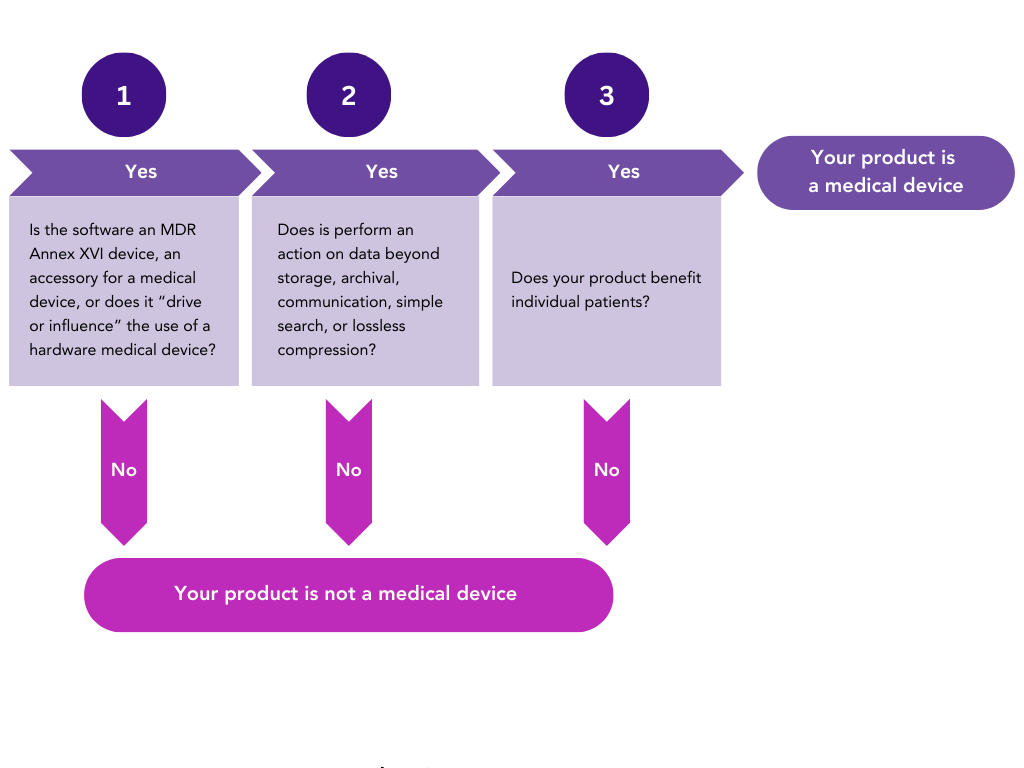
Step 1: Annex XVI refers to a very specific list of product groups which do not have an intended medical purpose but are still medical devices, for example contact lenses and certain equipment or substances used in cosmetic surgery.
Step 2: This question refers to the features of the software and the amount of processing being done by the software. For example, a software simply displaying guidelines to a clinician would unlikely be considered a medical device. Any actions beyond this could be considered medical device functions.
Step 3: The final question refers to the intended population and who the action is being performed for. Softwares intended only to aggregate population data would not be a medical device whereas software considered to be for the benefit of individual patients could be. Again, there are some nuances here but this is a good starting point to starting thinking about where your product might fall in terms of medical device status.
There are some key points to consider when developing medical devices, particularly if your device is relatively borderline. You must have evidence to support any medical claims you make, as the MHRA can ask to see this and can even force you to take your device off the market if you are not able to demonstrate the evidence required.
Considerations and claims around medical device status
You must have evidence to support any medical claims you make, as the MHRA can ask to see this and can even force you to take your device off the market if you are not able to demonstrate the evidence required.
There are some key points to consider when developing medical devices, particularly if your device is relatively borderline, including:
- Quotes or testimonials repeated in product literature or your website.
- Any medical claims you make, including adverts, app store description and category, your website and social media channels.
- If a consumer would view your product as a medical device: depending on the mode of action and manner of use as perceived by the consumer, or if it is possible for an objective observer, such as the MHRA or an averagely informed consumer to view a product as a medical device, the device could be considered a medical device.
- Adding general disclaimers (for example ‘this product is not a medical device’) are not acceptable if medical claims are made or implied elsewhere in the product labelling or associated promotional literature etc.
Non-medical device software
It’s important to note that not all software is a medical device, including:
- Actions such as “simple search”: this refers to the retrieval of records by matching record metadata against record search criteria or to the retrieval of information. This does not qualify as medical device software (eg library functions).
- Software intended for non-medical purposes: this includes invoicing or staff planning. This does not qualify as a medical device software and does not fall under the Medical Devices Regulations.
This highlights the importance of crafting a clear intended use as it will support you in determining the medical device status of your product, and communicating this to others.
Summary
In this module, Am I building a medical device?, we explored the definitions of medical devices in the UK and EU, as well as the importance of intended use for understanding your medical device status. After using this resource, you should have a understanding of the following:
The exact definition of a medical device varies by jurisdiction, so it is important to understand the regulations applicable to any country you plan to place the device on the market in.
Intended use statement is very important. It helps you understand your medical device status and risk classification, and communicate this with others. It is also one of the most important documents which submitted to the regulatory authorities and can help with communicating the value and limitations of your product to customers and payers.
Be clear and consistent with your claims. Anything you claim has to have evidence to back it up!
Quiz
Got questions, comments or feedback?Get in touch with the teamhin.mindset@nhs.net | felicity@hardianhealth.com
PowerPoint: Am I building a medical device? – click to download



Next module – Module 3: How are medical devices classified?
Back to Module 1: How is immersive technology for mental health regulated in the UK?