


Transforming the Lower Limb Wound Care Pathway – Information Hub
Background
The burden of chronic lower limb wound care is both a large and growing issue in England, accounting for at least 42% of all wounds in the UK. Hundreds of thousands of people in the UK live day-to-day with painful and slow-healing lower leg wounds such as leg ulcers. Due to their slow healing nature, these lower limb wounds have significant costs to the NHS every year. In 2019, the estimated associated healthcare cost of leg ulcers in England was £3.1 billion per annum (based on an estimate of 739,000 leg ulcers).

Across south east London, up to 5000 people are living with lower limb wounds each year. The Health Innovation Network (HIN) South London has been commissioned by the South East London (SEL) Integrated Care Board’s (ICB) System Sustainability Programme to support the transformation of lower limb wound care across the six boroughs: Bexley, Bromley, Greenwich, Lambeth, Lewisham, and Southwark.

Glossary
- Chronic lower limb wound This describes a wound below the knee that are slow, or fail, to heal.
- Leg ulcer This describes a break in the skin below the knee which has not healed within 2 weeks.
Note: both types of wounds listed above are different from regular wounds to the lower limbs that heal within a few weeks.
Are you a clinician?
For resources and best practice materials, visit the information page for clinicians.
Introduction
Between 2018 and 2024, the National Wound Care Strategy Programme (NWCSP) saw an improvement in lower limb wound healing rates – from 37% healed at 52 weeks, to 92% healed at 52 weeks. This followed pilots in which areas across the country where providers were supported to implement the evidence-based pathway.
The “Transforming Lower Limb Wound Care ” programme addresses the challenges in lower limb wound care across all six South East London boroughs by building on the learnings of the successful National Wound Care Strategy Programme.
This work could support the transition to the Neighbourhood Health agenda.
Aims
For patients, the implementation of the Lower Limb Wound Care guidance aims to improve their quality of life by helping them:
- Access evidence-based care for their lower limb wounds.
- Achieve faster healing times for their lower limb wounds, and reducing the likelihood of wound recurrence.
- Have an overall better journey through the healthcare system.
For clinicians, the pathway aims to:
- Access evidence-based care for their lower limb wounds.
- Achieve faster healing times for their lower limb wounds, and reducing the likelihood of wound recurrence.
- Have an overall better journey through the healthcare system.
Key areas of work
The programme aims to transform lower limb wound care by focusing on three key areas:
- People – The delivery of training to all staff supporting patients with lower limb wounds.
- Processes – Implementing the evidence-based pathway based on the recommendations from the NWCSP.
- Technology – Supporting data collection and provision of care through a digital lower limb wound management system.
Our partners
- All six south east London boroughs. Bexley, Bromley, Lambeth, Lewisham, Greenwich and Southwark.
- All patient groups. Ambulatory (someone who can move independently) and non-ambulatory (someone who cannot move independently).
- All care settings. GP practices, specialist clinics, and peoples’ homes (both private and care homes).
- All staffing groups. District/Neighbourhood/Community Nurses, Practice Nurses, Social Care Nurses in nursing homes, and Tissue Viability/Lower Limb Specialists/Complex Wound Care Nurses.
- SEL Community Provider Network (CPN) and four community providers. Bromley Healthcare CIC, Guy’s and St Thomas’ NHS Foundation Trust, Lewisham and Greenwich NHS Foundation Trust, and Oxleas Foundation Trust.
- Podiatry colleagues.
- Other agencies.
Resources
Preventing and Improving Care of Chronic Lower Limb Wounds – Implementation Case
National Wound Care Strategy Programme (NWCSP)
Venous leg ulcer management in clinical practice in the UK: costs and outcomes
International Wound Journal
Cohort study evaluating the burden of wounds to the UK’s National Health Service in 2017/2018: update from 2012/2013
BMJ Open
Commissioning for Quality and Innovation (CQUIN): 2023/24 – Guidance for leg ulcers managed in the community
NHS England
Projects
Latest

London Neighbourhoods Community of Practice resource hub
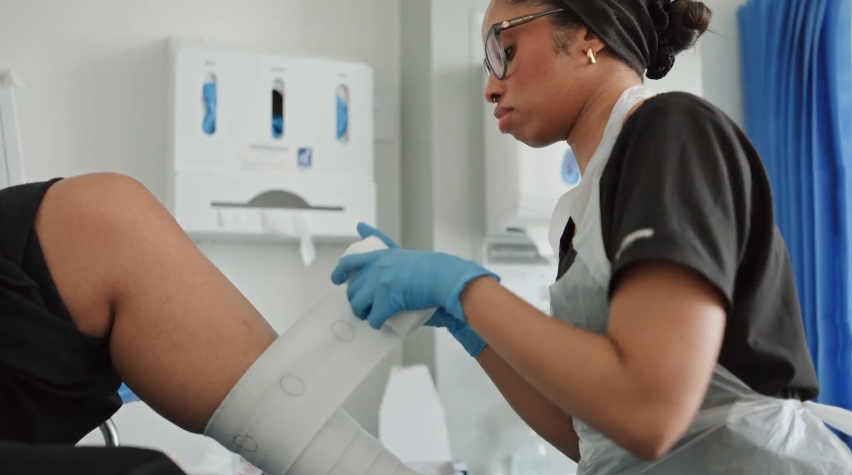
Transforming lower limb wound care programme in south east London – Information for clinicians
Transforming the Lower Limb Wound Care Pathway – Information Hub
Stay up to date
Our newsletter keeps you in the loop with the latest developments in health and care innovation.