
Mindset-XR Innovation Support Programme company spotlight: Reinhart


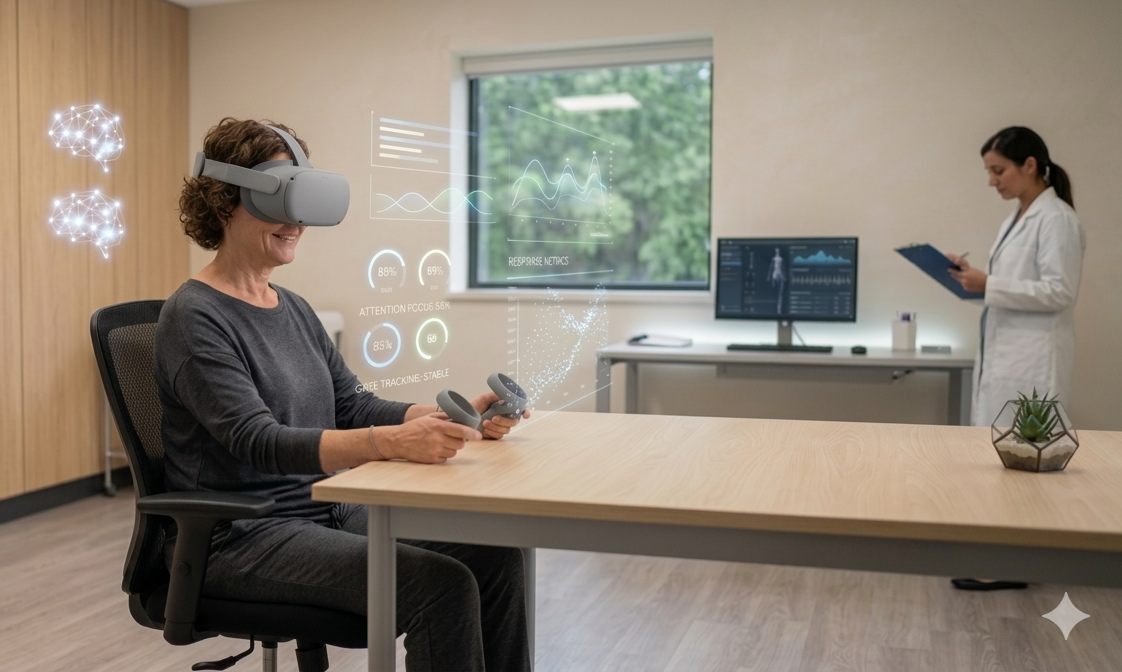
April's Mindset-XR Innovation Support Programme company spotlight shines on Reinhart whose pioneering virtual reality Eye Movement Desensitisation and Reprocessing (VR‑EMDR) solution, combined with pharmacological priming, is pushing the boundaries of immersive digital therapeutics for treatment‑resistant PTSD.

Reinhart’s PTSD solution, NEUROSYNC, is currently being rolled out across 13 European trial sites.

In the UK, the team is launching hospital pilots that include headset deployments alongside NHS demonstration days.

While large‑scale patient trials are only just beginning, early feedback from clinicians attending NHS demo days has highlighted the technology’s strong potential.


What three pieces of advice would you give budding innovators?

  • Secure clinical and regulatory buy-in early to navigate complex hurdles like MHRA approvals.
  • Build strategic, multi-disciplinary consortiums combining core tech with clinical execution.
  • Prioritise real-world scalability and autonomous delivery to ensure equitable access from day one.

What's the most exciting statistic or fact you have about XR in mental health?

The most exciting fact is our NEUROSYNC project: a massive 214‑patient adaptive trial across seven countries. We are testing the unprecedented combination of virtual reality Eye Movement Desensitisation and Reprocessing (VR‑EMDR) with pharmacological priming for treatment‑resistant PTSD, pushing the very boundaries of immersive digital therapeutics.

"This system could radically increase our treatment capacity."Consultant Psychiatrist

How has user feedback from patients and clinicians shaped your product?

Our Patient and Public Involvement (PPI) advisory panel, including veterans and refugees, directly shapes our protocols. Their feedback validated our 12-week waitlist design as ethically preferable to indefinite real-world waiting, and heavily influenced our home-use safety monitoring and remote follow-up procedures.

"This has the potential to mitigate workforce burnout."Clinical Psychologist

What is the biggest challenge you have faced so far in developing your innovation?

Navigating complex regulatory pathways has been our biggest challenge. Initially, this involved securing Medicines and Healthcare products Regulatory Agency (MHRA) and Integrated Research Application System (IRAS) approvals for our standalone VR-EMDR feasibility study in the UK. Now, it involves co-ordinating the multi-country NEUROSYNC study, managing an Investigational Medicinal Product (ketamine) alongside our device across seven European national frameworks.


How could your innovation tackle inequalities in mental health?

Our self-directed VR model reduces the need for verbal disclosure, making care more accessible for underserved groups such as neurodiverse individuals, refugees, and people affected by conflict. It enables scalable, at‑home support and helps address the 18–24‑month waiting times common in specialist trauma services.


Why should the health and care system be excited about your innovation?

Our plug-and-play VR-EMDR platform reduces reliance on therapists and helps ease workforce burnout. By enabling self-guided, remote use alongside medication support and in-person therapy, it significantly increases treatment capacity within existing teams, delivery meaningful cost savings per patient across European health systems.


What type of support are you seeking most from readers to help drive your project forward?

We are seeking clinical collaborators to expand our VR-EMDR trial sites across the NHS and Europe. Additionally, we welcome engagement from digital health investors to provide follow-on funding, enabling us to scale our platform commercially once clinical efficacy is definitively proven.


  • What XR success story would you like to share with us?

    Our consortium partner, SyncVR Medical, provides a fantastic success story. They have successfully deployed XR applications in over 100 European hospitals, including 25 NHS trusts. Their recent initiatives actively reduce patient anxiety, demonstrating immense real-world clinical appetite for immersive therapeutics.


What type of support are you seeking most from readers to help drive your project forward?

We are seeking clinical collaborators to expand our VR-EMDR trial sites across the NHS and Europe. Additionally, we welcome engagement from digital health investors to provide follow-on funding, enabling us to scale our platform commercially once clinical efficacy is definitively proven.

We’re always open to conversations and would be happy to connect. You can reach us at info@reinhart.uk

Want to find out more about our Mindset-XR Innovation Support Programme?

Sign up to our monthly newsletter and keep up to date with all the latest news

Click here
Mindset-XR Innovation Support Programme company spotlight: Neurotech


March's Mindset-XR Innovation Support Programme spotlight shines on Neurotech - an innovative startup applying engineering and high‑tech solutions to education and medicine, creating low‑cost VR and robotics tools that improve everyday life for people who might not otherwise access them.

Their Mindset-XR product FreedomXR is a mixed‑reality digital intervention, delivered through a VR headset, designed to support adults awaiting ADHD assessment by improving executive function, enhancing focus, and reducing impulsivity. It provides an accessible, low‑cost therapeutic option that patients can begin using immediately after referral, and it can also function alongside existing ADHD treatments.

Neurotech also develops other products including Talkback VR, an immersive XR platform supporting reading engagement for neurodiverse learners, and See4Myself, a VR and mobile platform helping neurodivergent young people explore careers and future pathways.

Below, we hear from founder Dr Jonah Dearlove about Neurotech’s innovative approach to designing accessible, high‑impact digital tools for neurodivergent learners, with a focus on how their solution FreedomXR is helping shape that work.


How has user feedback from patients and clinicians shaped your product?

Working with adults with ADHD drew our attention to important design blind spots. Their feedback on gamification and the level of structure required differed from our expectations and reshaped our interaction design.

Our clinical lead then helped translate those lived insights into mechanisms aligned with current neuroscience approaches to executive function.

“I like that there are multiple personalisation options. It's great that there are autism-friendly options. It makes it feel more open to someone like me.”Participant with ADHD and autism

Why should the health and care system be excited about your innovation?

Waiting times for ADHD assessment and support remain significant, leaving many people managing cognitive overwhelm alone. FreedomXR is designed to offer structured support aimed at improving cognitive stability during these gaps.

It complements clinical care by providing earlier, scalable symptomatic support alongside existing pathways.

“I have the impression that it has a lot of things that could be very helpful to me, and that there’s still so much more inside the app to explore.”Participant with ADHD

What is the biggest challenge you have faced so far in developing your innovation?

The biggest challenge has been bringing together different ways of seeing the problem, combining neuroscience, clinical practice, lived experience and immersive design into a coherent, usable system.

Aligning those perspectives isn’t always straightforward, but it’s essential. This is how we move beyond interesting technology and towards something people can meaningfully use in their daily lives.


  • “Overall, I’d say this is a way of achieving great things in a very fun way. It’s something I’d really like to use. I’m already anticipating it.”Participant with ADHD

    What XR success story would you like to share with us?

    A key success has been translating user-centred design findings into a clinically grounded XR prototype for adults with ADHD.

    Presenting this work at Leeds Digital Festival highlighted how our findings challenged aspects of conventional UX design thinking.

    It demonstrated how clinical leadership, lived experience and immersive design can be developed into something practical with real-world evaluation and delivery in mind.

    Watch here.


What type of support are you seeking most from readers to help drive your project forward?

We're keen to collaborate with organisations, including SMEs, working on Innovate UK, SBRI, or Horizon bids that need XR expertise, embedded clinical leadership or digital therapeutic delivery experience.

We’re experienced collaborators and reliable partners and would welcome conversations with NHS teams interested in early-stage pilot work.

We’re always open to collaborative conversations and would be happy to connect. You can reach us at contact@neurotech.biz

Want to find out more about our Mindset-XR Innovation Support Programme?

Sign up to our monthly newsletter and keep up to date with all the latest news

Click here

Mindset-XR Innovation Support Programme company spotlight: Photography Based Therapeutics

February's Mindset-XR Innovation Support Programme spotlight shines on Photography Based Therapeutics (PBT) an XR innovator helping young people express emotions through images rather than words.

Its research‑led, clinically tested approach turns everyday photography into a safe, structured way for young people to communicate how they feel, giving clinicians earlier, clearer insights and supporting those who struggle with traditional talk‑based therapies.

Below, we hear from founder Nicole Elias about PBT’s innovative approach to supporting young people, reducing waiting list pressures, championing SEND inclusion, and building a healthier image culture.


What advice would you give budding innovators?

  • Enjoy listening to your users. They will tell you what really matters.
  • Get comfortable with moving slowly when building trust and ensuring safety.
  • Aim for simplicity – clarity is care too!


How has feedback from patients and clinicians shaped your product?

PBT has been shaped through direct, ongoing co-design with young people since 2020, who have been highly specific about what works and what doesn’t.

Their feedback has guided not only the interface, but also the platform’s governance — from clear privacy boundaries to emotional pacing and safe ways of engaging with difficult feelings.

Clinicians have responded positively to PBT's approach, recognising the value of a structured, non-verbal system that supports reflection and continuity without increasing clinical burden.


Why should the health and care system be excited about your innovation?

PBT offers early visibility into emotional patterns before, between and after appointments, while allowing young people to retain control over what personal content is shared.

Trends are highlighted that help services prioritise the most vulnerable, support engagement and understand longer-term insights. Feedback from users has been incredible.

“As I’m dyslexic, taking photos gives me another way to understand my feelings. I can take pictures anytime and anywhere, and then when I’m with someone, I can use them to talk about how things make me feel. It’s just an easier way for me to express myself.”Armand, 10

What is the biggest challenge you have faced so far in developing your innovation?

Resisting the pressure to move fast at the expense of trust. Ensuring young people retain control over privacy and consent while still generating meaningful clinical insights has required deliberate, careful design rather than rapid deployment.


  • How could your innovation tackle inequalities in mental health?

    PBT uses photos as a way for young people, who struggle with traditional, talk-based models, to express themselves without needing to talk. As it works on any device, it can be used in schools, at home, or in clinical settings, helping remove barriers related to language, confidence, or neurodiversity.


    How is user patient involvement incorporated?

    Young people lead the process — they’ve been involved from the very beginning through co‑design and ongoing feedback. They’ve shaped what should stay private, what insights can be used, and what should never surface - ensuring PBT is trusted, safe, and firmly grounded in their lived experience.


What type of support are you seeking most from readers to help drive your project forward?

We’re eager to build strong connections with research organisations and those wanting to shape the next phase of evaluation and research into safe, non‑verbal digital mental health tools.

If you are interested in finding out more, email nicole@pbt.life.

We’d love to hear from you.

Want to find out more about our Mindset-XR Innovation Support Programme?

Sign up to our monthly newsletter and keep up to date with all the latest news

Click here

Mindset-XR Innovation Support Programme company spotlight: Propeer Solutions

For January, our Mindset-XR Innovation Support Programme company spotlight shines on Propeer Solutions Ltd -  innovators in immersive virtual and augmented reality technologies. Their solutions enable users to safely engage with realistic scenarios and challenges, particularly focusing on supporting those affected by post-traumatic stress disorder.

Below, we hear from founder Chris Thomas who shares insights about the company and his innovative approach to treating PTSD.


What advice would you give budding innovators?

  • Engage early with decision-makers to align your innovation with procurement needs, service priorities and real-world implementation pathways.
  • Understand the problem you’re trying to solve and the value your solution will help address these pains.
  • Collaborate closely with end users to ensure it’s practical and effective.


How has feedback from patients and clinicians shaped your product?

User feedback has been fundamental. By developing the platform in iterative phases, we ensured clinicians and patients could continuously provide input.

Their insights directly informed features and usability, helping us create a solution that is both clinically relevant and meaningful for end users.


Why should the health and care system be excited about your innovation?

Co-developed with clinicians, our intuitive and easy-to-use platform delivers immediate therapeutic impact. It supports reduced waiting times, optimises clinician time, and improves patient outcomes. Crucially, it offers the potential to establish a new gold standard in delivering effective, scalable, and personalised mental health care.


  • What XR success stories would you like to share with us?

    One patient, traumatised by a road traffic accident, had tried multiple therapies over 10 years with limited success. After just a few sessions using our platform, her trauma scores dropped significantly, enabling therapy to conclude and restoring a meaningful quality of life.

    Another user of the solution reported significant benefits from having a therapist present while reliving their traumatic experience.

    "You relive it in your head but to see it in a virtual world - to see that location as part of your therapy when your therapist is there with you - for me, it was hugely beneficial."User of Propeer Solutions' innovation

    Clinicians have expressed a high level of satisfaction with this solution, noting its effectiveness and value in supporting their clinical practice.

"I thought it was amazing. I thought how much easier it is to do exposure therapy and how quickly the trauma was resolved."Clinician

What type of support are you seeking most from readers to help drive your project forward?

We’re eager to build strong connections with research organisations and those involved in NHS trials.

If you work in either of these areas anywhere in the UK, we’d love to hear from you.

Please email me at chris@propeersolutions.comto start the conversation.

Want to find out more about our Mindset-XR Innovation Support Programme?

Sign up to our monthly newsletter and keep up to date with all the latest news

Click here

Mindset-XR Innovation Support Programme company spotlight: Little Beginnings

For December, our Mindset-XR Innovation Support Programme spotlight is on Little Beginnings Ltd and their solution Rumii.

Little Beginnings Ltd, founded in 2021 by Dr Fin Williams, uses immersive extended reality to help young people maintain mental wellbeing.

Their mission is to make every smartphone a mental health guardian.

Rumii — a web app and platform already piloted in six schools — passively analyses smartphone data on behaviours, habits, and relationship to phones to detect signs of mental health decline.

When the algorithm detects changes in these patterns, it responds with supportive nudges and conversational AI that helps guide behavioural change.

Below, we hear from Fin who shares insights about the company and her innovative approach to wellbeing.


What advice would you give budding innovators?

Build a strong network - not just your immediate team, but also fellow founders for guidance and strategic advisors who can shape your go-to-market strategy and open key connections.


What's the most exciting fact you have about the use of XR in mental health?

The most exciting impact is the deeper sense of immersion and its effect on engagement.

A 2022 study in Frontiers in Psychology found that 70% of participants felt more engaged and experienced a stronger sense of presence.

For us, using Augmented Reality to create vivid visual memory imprints for breathwork and compassion practices offers the potential for these techniques to be recalled more easily when they’re needed most.

What is the biggest challenge you have faced so far in developing your innovation?

Funding! And the pace of change in the tech. We’re in one of the toughest climates, expanding into new market sectors, with technology that is advancing all the time.

The bar for demonstrating impact is much higher with potential investors, so we’ve had to be highly creative in what we develop and how we allocate funds to reach the next milestone.

Why should the health and care system be excited about your innovation?

Our ability to use raw sensor data to passively detect and proactively support means we can enable remote patient monitoring, early detection within the health system, and timely intervention without relying on young people to report or seek help, which is often hardest when they’re struggling.

This impact is already resonating with users; as one person who trialled our product shared, “I’ve never seen anything like this before - it’s great to be able to see my behavioural health like this!”


  • How could your innovation tackle inequalities in mental health?

    Globally, there’s a shocking statistic: only one therapist for every 200,000 people, yet 70% of the world has access to a smartphone — actually higher than access to a toilet!

    We use the smartphone sensors to passively detect and proactively support mental health. With such widespread access to smartphones, our aim is to improve access to support globally.


    What type of support are you seeking most from readers to help drive your project forward?

    We’re eager to build strong connections with those involved in NHS trials, Contract Research Organisations, remote clinical providers, and pharmaceutical companies as these are the types of  organisations where remote patient monitoring can actively be used to provide trial support, medication adherence, and proactive early intervention in long term conditions.

    If you work in any of these areas anywhere in the UK, we’d love to hear from you.

    Please email us at fin@rumii.app to start the conversation.

Want to find out more about our Mindset-XR Innovation Support Programme?

Sign up to our monthly newsletter and keep up to date with all the latest news

Click here

Saved by social: can young people be helped to cope online with social networks

Saved by social: supporting young people with mental health challenges using apps

By Rita Mogaji, Digital Marketing Manager at Health Innovation Network

I love social media. I love everything about it. I love that you can learn most things, connect with likeminded people, or even better, very different people from all over the globe. In that one click a whole world of interests, breaking news and funny memes is opened up to you. As Digital Marketing Manager of Health Innovation Network, I get a kick out of being able to share the latest digital innovations with healthcare professionals, connect with GPs on how they can bring Atrial Fibrillation (AF) checks to their clinics and – of course – stay up to date with the latest gifs, all through the power of social media.

But I appreciate that’s not everyone’s experience of the cyber world. And, while I am a lover of the online world, I am not ignorant to the darker side, where bullies troll and perfection is presented as a casual everyday occurrence. This is particularly saddening in the way that it is potentially affecting young people’s mental health.

In February, HIN hosted a Maximising Digital in Mental Health event, specifically aimed at discussing how we can maximise digital  opportunities in mental health for 0-25 year olds. At the event, leading children’s mental health expert and Professor of Contemporary Psychoanalysis and Developmental science and Head of the Division of Psychology and Language Sciences at University College London (UCL), Professor Peter Fonagy OBE, brought the problem to life in the statistics he presented. According to the first national review of children and young people’s mental health, the number of children and young people referred for mental health treatment has risen by two-thirds since 2012, university students reporting a mental health problem has risen five-fold.

The same report, titled “Impact of social media and screen-use on young people’s mental health”, published in 2018, found that despite there being a disappointing amount of robust research in this area, there was evidence of the potential negative impacts of social media, ranging from causing detrimental effects on sleep patterns and body image, through to cyberbullying, grooming and ‘sexting’. In these instances, social media was described as a facilitator to the risk, rather than the general root cause.

What if instead of carrying around trolls and bullies and anxieties in their pockets, young people were carrying around peer support and mental health professionals.

Harnessing the power of sharing

If social media is a facilitator to the risks, surely, it could also be a facilitator to a solution? While social media’s potential to be destructive and unkind cannot be denied, it also provides direct access to young people who otherwise are not accessing the professional help they need.

Research recently published by the Education Policy Institute (EPI) found that one in four children and young people referred to mental health services in England last year were not accepted for treatment, and those who are accepted have to wait an average of two months to begin treatment. What if we harnessed the power of social sharing? What if instead of carrying around trolls and bullies and anxieties in their pockets, young people were carrying around helpful advice through peer support and  mental health professionals. The same touch of a button that could see them post their latest adventure, is the same single-click with which they can access potentially life-saving help.

Facebook asks us what’s on our mind, LinkedIn asks us if we want to connect. What if we created bespoke social networks that used these mechanisms and approaches to help young people feel comfortable opening up to professionals who could help them? What if the technology for this already exists?

BESTIE, an app created by a team of young people, NHS professionals from Worcestershire Health and Care Trust and digital innovators, combines digital media, instant messaging, built-in games and supportive help and information within a safe, anonymous, online platform. Kooth is a digital tool that provides easy access to an online community of peers and a team of experienced counsellors, which more than 1,500 children and young people across England log in to everyday.  Calm Harm is a multiple award-winning app to help young people manage their urge to self-harm, which has been downloaded 1.13 million times worldwide and reports a 93 per cent reduction in self harm behaviour after each use.

The effectiveness of these innovations? They have taken the end user’s behaviours and preferences into account.

Time to listen

Time to Change, is actively campaigning to bring mental health to the public consciousness with its movement to get more discussions about our mental wellbeing out in the open – and that’s great. listening to the discussion at our digital mental health event it struck me that for young people it’s not only time to talk; it’s time for us to listen. Young people want to talk about their problems, we need to give them opportunities for exchanges they feel comfortable with.

Young people want anonymity. An irony that I’m sure isn’t wasted on anyone is young people’s desire for anonymity when it comes to mental health. When co-creating the Chat Health app with young people, the ability to be anonymous and create avatars was a much requested functionality. The same people who crave sharing their every dinner, dance move or new outfit, may want to remain faceless when talking about their personal challenges.

Young people want to text. During the Maximising Digital in Mental Health event we heard from different people about how young people felt that the telephone was too personal and they didn’t always feel comfortable talking to an ‘adult’ about the challenges they might be facing. But texting made it easier to talk and was more aligned with how they usually used their smartphones.

Young people want to be involved. Most of us are not digital natives, now most commonly determined by you having owned a smartphone from the age of 12. But most young people growing up are. The same way their feedback is adapted in every other app they interact with to personalise it to their specific preferences; they want co-design and to know they have helped shape and inform the end product.

Closing the gap

Deprivation heightens a young person’s propensity to experience mental health challenges. Dr Fonagy described how you can almost perfectly follow the underground line from east to west across south London, mapping the deteriorating outcomes and quality of care that children receive based on where they are from. On the face of it, investing in digital may serve to only increase this socio-economic divide. However, in the young person’s category access to technology is possibly less of  a concern with 96 per cent of 16-25 year olds own a smartphone, with tablet access expected to reach similar ownership in the next few years.

Younger generations will continue to become more digitally aware and savvy, and as a result, more susceptible to the negative sides of such digital maturity, and at an even younger age. So instead of all of our efforts going into stopping the rise of social media or preventing young people’s access, I believe we should  harness the power of social media to offer them support, help and – most importantly – the tools to manage their own mental wellbeing.

Young people want to talk about their problems, we need to give them opportunities for exchanges they feel comfortable with.

Check out the full list of digital tools presented at our Maximising Digital opportunities in mental health 0-25 years event, which also included tools to support new parents.

BESTIE is a mobile application that aims to help reduce the mental health risks of social media to children and young people. It combines digital media, instant messaging, built-in games and supportive help and information, all within an anonymous, safe online platform.

Baby Buddy is an award-winning, quality-assured pregnancy and parenting app, providing timely, relevant and personalised, bite-sized daily information for parents and families. The app signposts people to local support help lines and ensures new parents are confident and equipped to make decisions about their child and themselves during pregnancy and early parenthood.

BfB Labs’ mission is to develop and deliver highly engaging, clinically evidenced and cost-effective digital interventions that provide timely and effective support to young people so they can improve and sustain their mental health. BfB Labs evidence-based digital treatment interventions can be delivered at all points in the care pathway: before, during and after clinician-led support. Evidence

Calm Harm is a multiple award-winning app to help young people manage their urge to self-harm using ideas from evidence-based Dialectic Behaviour Therapy (DBT). The app has been downloaded 1.13 million times worldwide with a reported 93 per cent rate in the reduction of self-harm behaviour after each use.

ChatHealth is a multi-award-winning, risk-managed messaging helpline platform, providing a way for service users to easily and anonymously get in touch with a healthcare professional. Backed by NHS England’s Innovation Accelerator, evaluated by NICE and NHS Digital, ChatHealth is used by half of public health school nursing teams in England.

The free-to-download distrACT app by Expert Self Care allows NHS and other providers to give people easy, quick and discreet access to information around self-harm and suicidal thoughts. Created by a team of experts in self-harm and suicide prevention, doctors, NHS organisations and charities, the app can be customised for local areas that want to signpost local services and support all in one place.

Dr Julian is an innovative mental healthcare platform that increases accessibility of mental healthcare. It connects patients almost immediately to mental healthcare therapists by secure video/audio/text appointments using a calendar appointment booking system, which matches a patient to the correct therapist using filters such as language, issue and therapy type.

QbTest is a continuous performance test (CPT) that simultaneously measures the core indicators of ADHD: attention, impulsivity and motor activity. Evaluation of the QbTest showed pathway efficiencies, quicker diagnosis, release of clinical workforce time and improved patient experience.

Recognising that one in four young people who use a smartphone have experienced depression, anxiety, perceived stress and poor sleep, Humankind designed the pocket digital trainer, Goozby, which improves sleep, concentration and sedentary behaviour, using behaviour science and health analytics.

Kooth, from XenZone, is a transformational digital mental health support service. It gives children and young people easy access to an online community of peers and a team of experienced counsellors. Access is free of the typical barriers to support: no waiting lists, no thresholds and complete anonymity. Evidence here and here

MeeTwo is a multi-award winning fully moderated, anonymous peer support app for young people aged 11-23. MeeTwo integrates the latest psychological research to promote the development of protective factors such as emotional resilience, empathy, social skills, stress management and coping techniques. Evidence

Mind Moose builds digital tools to support early intervention in children’s mental health. They are currently piloting virtual reality (VR) and online emotional support to help children with their mental and emotional wellbeing.

Mum & Baby app is a personalised digital toolkit to support women and their families through pregnancy, birth and beyond with access to local, national and international guidance and resources.

Mush brings women together to prevent social isolation and reduce anxiety in pregnant women and new mums. It empowers women to build local friendships, share advice and find support from an understanding community.

My Possible Self is the mental health app clinically proven to reduce stress, anxiety and low mood, developed by our team of in-house psychologists. The app empowers people to become their best possible self by using proven psychological methods and clinically-proven research from world-leading experts in e-mental health research.

Shout is the UK’s first 24/7 text service, free on all major mobile networks, for anyone in crisis anytime, anywhere. Shout exists in the US as ‘Crisis Text Line’, but this is the first time the tried and tested technology has come to the UK. The anonymised data collated by Shout gives unique insights into mental health trends to help improve people’s lives.

Share this Post